

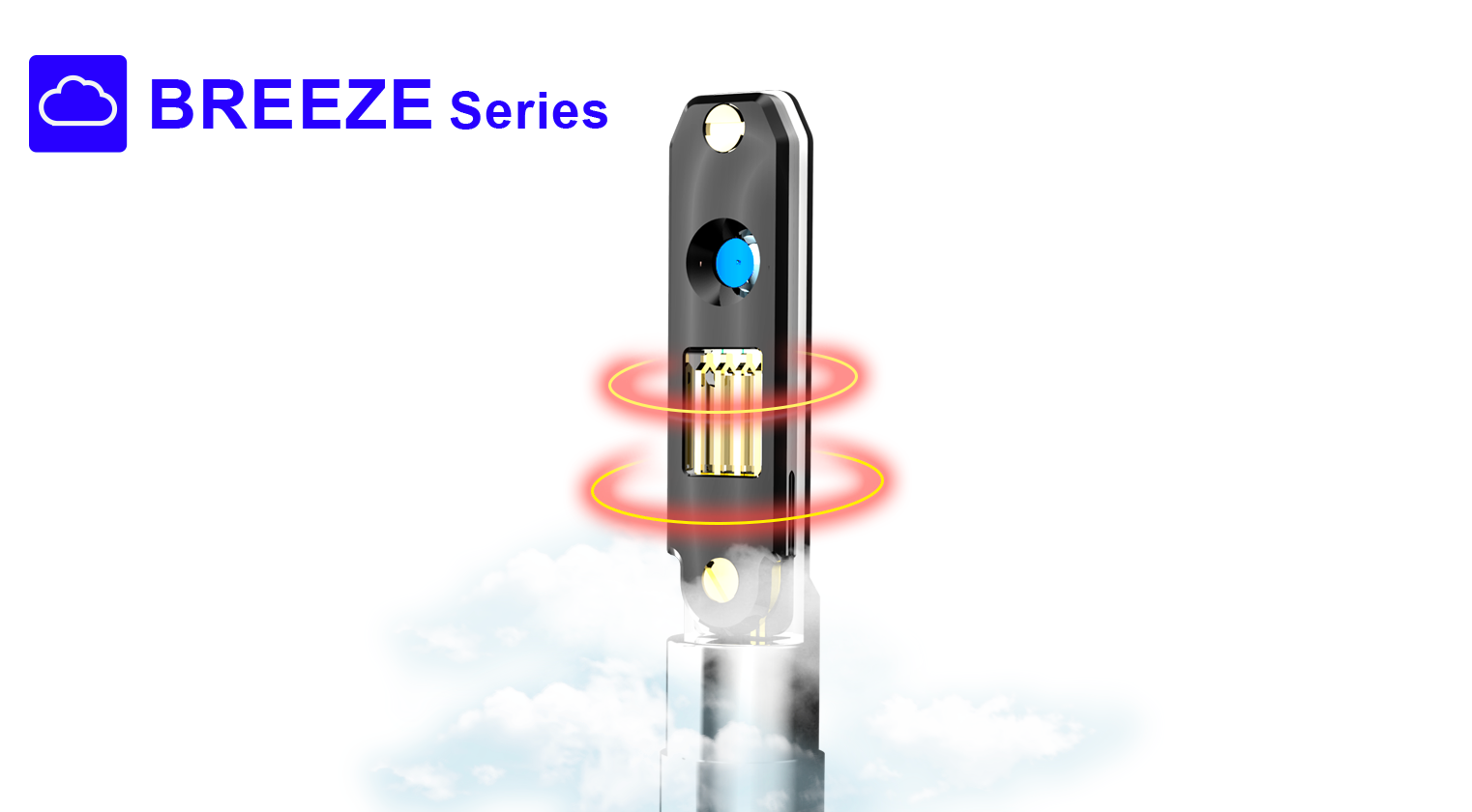
Breeze Series In-Situ Holders(Optics&Heating)
Product Features
A multi-field automatic control and feedback measurement system integrating light and thermal fields is constructed within the in-situ sample stage, utilizing light sources introduced via MEMS chips and optical fibers. By combining multiple characterization modes including EDS, EELS, SAED, HRTEM, and STEM, real-time and dynamic monitoring is achieved at the nanoscale or even atomic scale. This monitoring captures key information such as the microstructural evolution, reaction kinetics, phase transitions, elemental valence states, chemical changes, microstress, and atomic-scale structural/compositional evolution at the surfaces/interfaces of the sample in a gaseous environment, as the sample responds to variations in light and thermal fields.
- Product composition
- Unique Advantages
- Functional Parameters
- Application
-

a.Breeze Series In-Situ Holders(Optics&Heating) b.MEMS Gas Heating Cell Chip c.Heating Control Software d.Thermal Controller e.High Vacuum Leak Checking Station f.In-situ Nanofluidic Control System (Gas) g.High-precision Chip Assembly Instrument h.light Source Station i.Accessory Package -
High resolution in gas environments ·1.The original MEMS processing technology enables the silicon nitride film in the chip window area to be as thin as 10 nm. ·2.The chip packaging adopts a dual-security approach combining bonded internal sealing and epoxy resin external sealing, resulting in an interlayer between chips as thin as approximately 100–200 nm. This ultra-thin interlayer significantly reduces interference with the electron beam, enabling clear observation of the atomic arrangement of the sample, while achieving picometer-level resolution in a gaseous environment. High security ·1.Nanofluidic technology is adopted, and fluid differential control is implemented via a piezoelectric microcontrol system to achieve nanoliter-scale microfluid delivery with a control precision of 5 nL/s. During each gas pushing process, the redundant gas volume in the in-situ nanofluidic system and the sample rod is only at the microliter level, effectively ensuring the safety of the electron microscope. ·2.By adopting the polymer membrane surface contact sealing technology, compared with O-ring sealing, the sealing contact area is increased, which effectively reduces the risk of leakage. ·3.By adopting the ultra-high temperature coating technology, the silicon nitride film in the chip window area exhibits advantages such as high temperature resistance, low stress, pressure resistance, corrosion resistance, and radiation resistance. Excellent Thermal Performance ·1.High-precision infrared temperature measurement and calibration, coupled with micron-scale high-resolution thermal field measurement and calibration, ensure temperature accuracy. ·2.High-stability precious metal heating wires (non-ceramic materials) are adopted, which serve as both thermal conductive materials and thermosensitive materials. Their resistance exhibits an excellent linear relationship with temperature. The heating area covers the entire observation region, enabling fast heating and cooling rates, along with a stable and uniform thermal field. The temperature fluctuation is ≤±0.01℃ under steady-state conditions. ·3.A temperature control method featuring closed-loop ultra-high-frequency dynamic control and ambient temperature feedback is employed. High-frequency feedback control eliminates errors, achieving a temperature control precision of +0.01℃. ·4.The unique multi-stage composite heating MEMS chip design controls thermal diffusion during the heating process, significantly suppressing thermal drift during temperature rise and ensuring efficient observation in experiments. Excellent Optical Performance ·1.Integrated laser light source: It integrates ultraviolet (UV), visible, and infrared (IR) bands, and outputs lasers with specific wavelengths. It features strong optical signals (maximum intensity not less than 150 mW/cm²), enables rapid and continuous adjustment of light source intensity, and has a short response time (millisecond level). ·2.Special structural design ensures ultra-low light loss, as well as stable and uniform energy output. Intelligent Software and Automated Equipment ·1.Man-machine separation is realized: gas conditions can be remotely controlled, and detailed experimental data is automatically recorded throughout the entire process, facilitating experiment summary and review. ·2.Customizable programmed temperature-rise curves. It supports defining more than 10 temperature-rise steps, constant temperature duration, etc. Meanwhile, the target temperature and duration can be manually controlled. If there is a need to adjust the temperature (for temperature change or constant temperature) during the programmed temperature-rise process, the experimental scheme can be modified in real time, improving experimental efficiency. ·3.A built-in absolute temperature calibration program, each chip temperature control can be based on the change of resistance value to recurve fitting and correction, to ensure the accuracy of temperature measurement, ensure the reproducibility and reli ability of high temperature experiment. ·4.Precision automated equipment is equipped throughout the entire workflow to assist manual operations and improve experimental efficiency. -
Category Index Functional Parameters Basic parameters Rod Material High strength titanium alloy The number of electrodes 2 Window thickness 20nm(Support ugrande to 10nm) Applicable TEM brand Thermo Fisher/FEI, JEOL, Hitachi Applicable Pole Piece ST, XT, T, BioT, HRP, HTP, CRP,FHP,WGP (HR)TEM/STEM Supported (HR)EDS/EELS/SAED Supported -

Related Products

E-mail:
Add:
Room 206, North Building, Weiye Building, Innovation and Entrepreneurship Park, No.11 Huohui East Road, Huli District, Xiamen City, Fujian Province